There are some problems that are inherently intractable to solve, meaning that no efficient solution exists for all cases. e.g.
- The game of Go
- Protein folding
How about design an agent that learns a set of function to solve the problems mentioned above.
Machine Learning
Supervised learning
Learning from labeled data to learn a mapping from inputs to outputs
Think about Data, Model, Loss
- Data: A set of input-output pairs that the model learns from
- We assume that the data comes from the ground truth
- Model: A function that predicts the output based on the input features
- Loss: A function that is often used by a learning algorithm to assess the model’s ability in making predictions over a set of data
Phases:
- Training phase
- Testing / evaluation phase
- Estimates the generalisation of the model: how well the model will perform in real-world when facing new unseen data.
Tasks
- Classification
- Predict a discrete label from a set of predefined classes based on input features
- The output variable is a categorical value
- e.g. cancer prediction, spam detection, document categorization
- Regression
- Predict a continuous numerical value based on input features
- The output variable is a real number
- e.g. house price prediction, temperature prediction, sales forecasting
Model
A model refers to a function that maps from inputs to outputs h: X ⇒ Y and that can be learned by a learning algorithm
- we want the find a model h(x) that best predicts the set of outputs given a set of inputs.
Performance Measure and Loss Functions
Functions that take in a dataset and a model and return a number representing how well predicts the mapping x→y
- Examples include Mean square error (MSE), Mean absolute error (MAE)
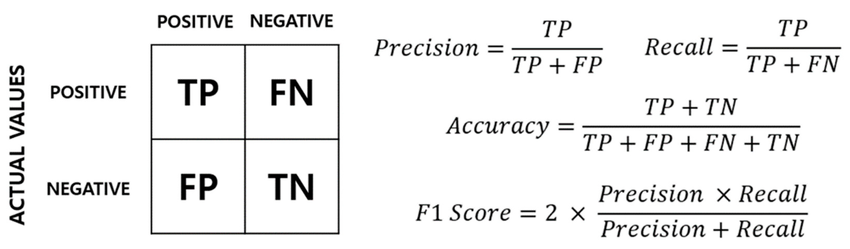
- Accuracy , confusion matrix, precision, recall, f1-score
Unsupervised learning
Learn from unlabelled data to find patterns or structure