Microprocessor without Interlocked Pipeline Stages (MIPS)
Programming Language —(compiled)⇒ Assembly Language —(Assembler)⇒ Machine Language ⇒ Processor (MIPS)
Instruction Set Architecture
Abstraction on the interface between the hardware and the low-level software
- ISA contains the set of instruction that the processor can support.
- E.g. it is a manual for the processor.
Machine Code vs Assembly Language
| Machine Code | Assembly Language |
|---|---|
| Instructions in Binary | Human readable |
| Hard and tedious to code | Easier to write than machine code, symbolic version of machine code |
| May also be written in hexadecimal of a more human-readable format | May provide ‘psuedo-instructions’ as synthetic sugar |
Walkthrough of C Code ⇒ Assembly Code
for (i=1; i<10; i++) {
	res = res + 1;
}
Compiles to (not real assembly languagea)
res <- res + 1
i <- i + 1
if i < 10, repeat
Walkthrough of Components

- Code and data reside in memory
- Transferred into the processor during execution
- Problem: Processor is always much faster than the memory.
- Hence, temporary storage for values in the processor: registers
- load: move data from memory into register
- store: move data from register into memory
- 3 Type of instructions
- Memory: Move values between memory and register
- Calculation: Arithmetic
- Control Flow: Change the sequential execution
Registers
- Fast memories in processor
- A typical architecture has 16 to 32 registers
- They do not have data type
- Machine instruction assumes that data in register is of the correct type
- add (signed numbers): 32-bit 2’s
- addu (unisigned numbrs): 32-bit unsigned binary
- fadd (floating point): IEE-754
- There are 32 registers in a MIPS Processor
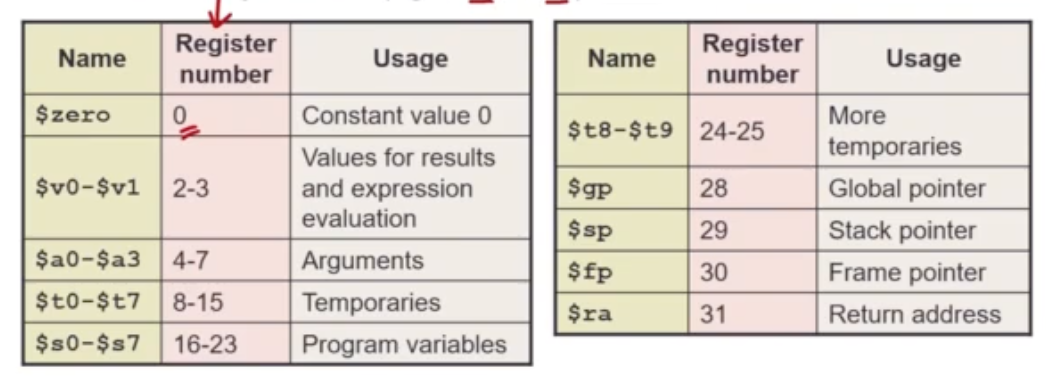
- even if u assign the value 5 to register 0, the value will be stored as 0
- should not change/ touch registers 28-31
MIPS Assembly Language
Each instruction executes a simple command
add $s0, $s1, $s2- MIPS Arithmetic operations have 3 operands: 2 sources and 1 destination
- $s0 is the destination (gets the result)
- s2 are the sources
- add is the operation
- C Statement → MIPS Assembly language is known as variable mapping
- Variables are mapped to the registers
Arithmetic Operations
Addition
add $s0, $s1, $s2Subtraction
sub $s0, $s1, $s2Complex C Code → MIPS
a = b + c - d;- s1 → b, s3 → d
add $t0, $s1, $s2
sub $s0, $t0, $s3
- Use t7 for intermediate results Addition of constant values
addi $s0, $s0, 4
- e.g. c code
a = a + 4 - Immediate values are numerical constants
- Constant ranges from to
- 16-bit 2s complement number system
subidoes not exist because you can useaddiwith a negative constant- minimize the number of instructions Register Zero, zero
- Used for initialisation
- e.g. c code :
f = gorf = g + 0 - MIPS Assembly Code:
add $s0, $s1, $zero - Known as pseudo-instruction (move)
- e.g.
move $s0, $s1is actually the MIPS Assembly Code as shown above. - CS2100 will try to avoid pseudo-instruction
- e.g.
Logical Operations
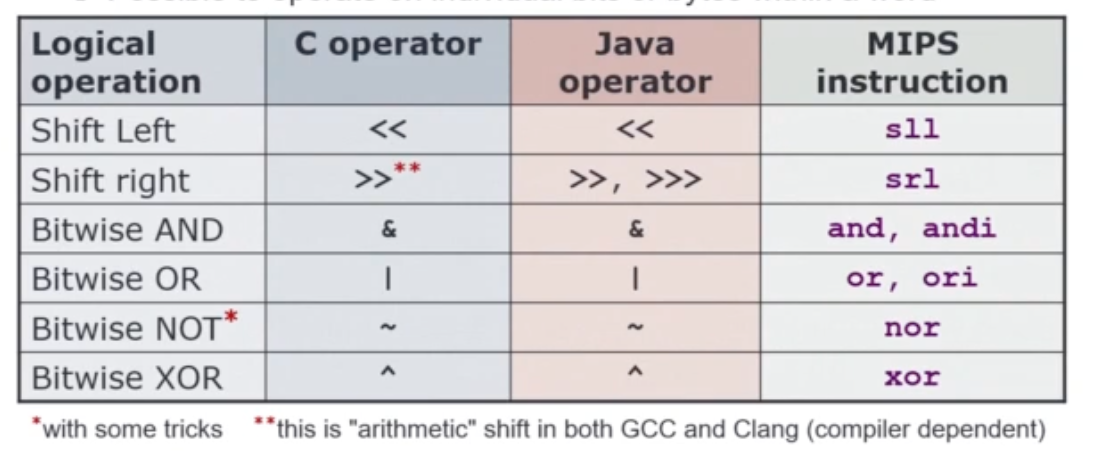 AND
AND
- 1 if both a and b are 1. Otherwise, 0 OR
- 0 if BOTH a and b are 0. Otherwise, 1 NOR
- 1 if BOTH a and b are 0. Otherwise, 0 XOR
- 1 if a is not the same as b.
Shifting
sll: move all the bits in a word to the left by a number of positions
$s0: 1011 1000 0000 0000 0000 0000 0000 1001
sll $t2, $s0, 4
$t2: 1000 0000 0000 0000 0000 0000 1001 0000
- the emptied positions are filled with 0s
- Maximum number of shifts you can do is 31
srl: move all the bits in a word to the right by a number of positions
- same logic as
sll
Equivalent Number of bits for sll /srl
sll: multiply by where represents the number of bits shifted to the leftsrl: division by where represents the number of bits shifted to the left
Bitwise AND
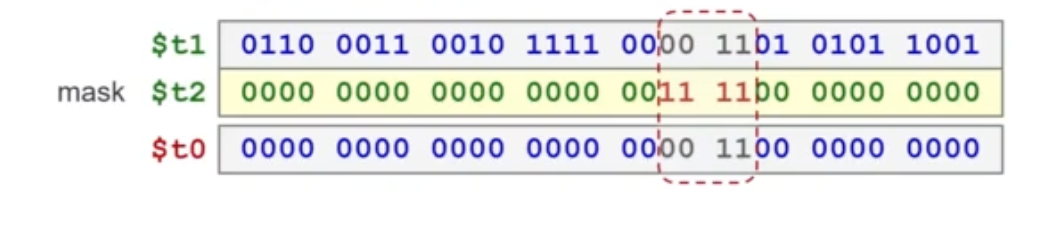
and $t0, $t1, $t2
- you can put
1111in the positions you are interested in for $t2 - therefore, the output, t1
- you are using $t2 as a mask
- Masking operation!
- has
andiinstruction
andi $t0, $t1, 0xFFF
- Mask over the last 12 bits of $t1
Bitwise OR
- force certain bits to 1
oriis available
ori $t0, t1, 0xFFF
$t0: 0000 1001 1100 0011 0101 1111 1111 1111
Bitwise NOR
- use nor instruction to do NOT instruction!
- let the variable be 0
- 0 nor 1 → 0
- 0 nor 0 → 1
nor $t0, $t0, $zero
- Why is there no instruction for NOT?
- Keep instruction set small
noriis not present in MIPS
Bitwise XOR
- use XOR instruction to do NOT instruction !
- let the variable be 1
- 1 XOR 1 → 0
- 1 XOR 0 → 1
xor $t0, $t0, $t2where$t2is all 1s
xoriis present in the MIPS instruction set
Loading a large constant into a 32-bit Register
Consider: $t0 = 1010 1010 1010 1010 1111 0000 1111 0000
New Instruction
- load upper immediate:
lui
lui $t0, 0xAAAA
- Loads the first 16 bits into
$t0 - $t0:
1010 1010 1010 1010 0000 0000 0000 0000 - User
orito load lower 16 bits
ori $t0, $t0, 0xF0F0
- $t0:
1010 1010 1010 1010 1111 0000 1111 0000
Memory Organisation
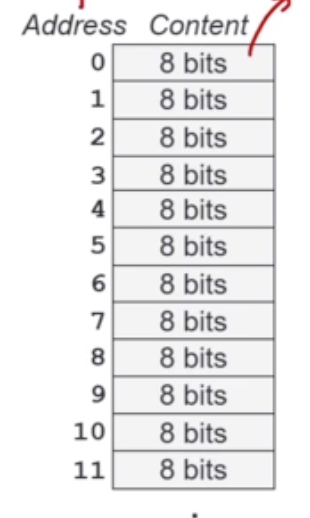 Single-dimension array of memory locations
- Given k-bit address, the address space is of size
- e.g. address is 3-bits, it can have , 8-bits address space
- Address on the right contains one byte (8-bits) in every location/ address
Memory Transfer Unit
- Single byte or single word
- Single Word
- usually bytes
- Common unit of transfer between processor and memory
- word size will normally coincide with the register size, the integer size and the instruction size in most architecture
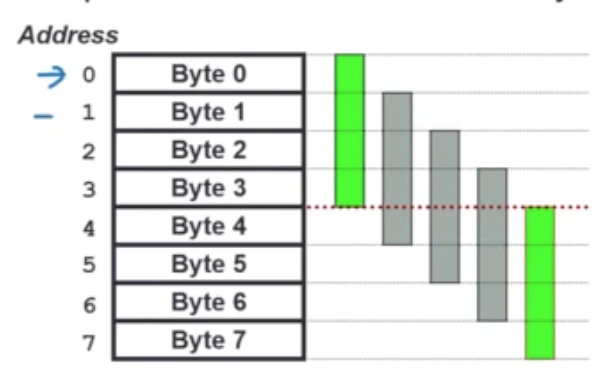
- Word Addressable memory: can only use address 0 and 4
- Otherwise, will lead to mis-aligned word!
- How do we check if a given memory address is word-ailgned?
- Check if address % 4 == 0
- 4 is the word size (number of bytes)
- Byte Addressable memory: can use all the addresses 0 to 7
Memory Instructions
32 registers, each 32-bit long. Each word is 32 bit long. MIPS = load-store register architecture
Load Word Memory Instruction
lw $t0, 4($s0)
$t0is the destination,4is displacement,$s0is source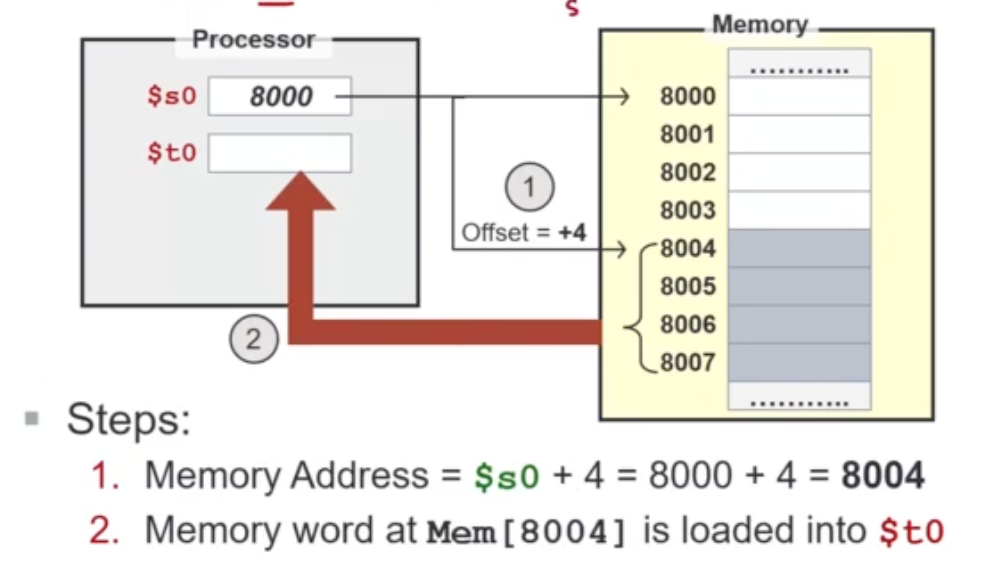
- move from memory into the register
Store Word Memory Instruction
sw $t0, 12($s0)
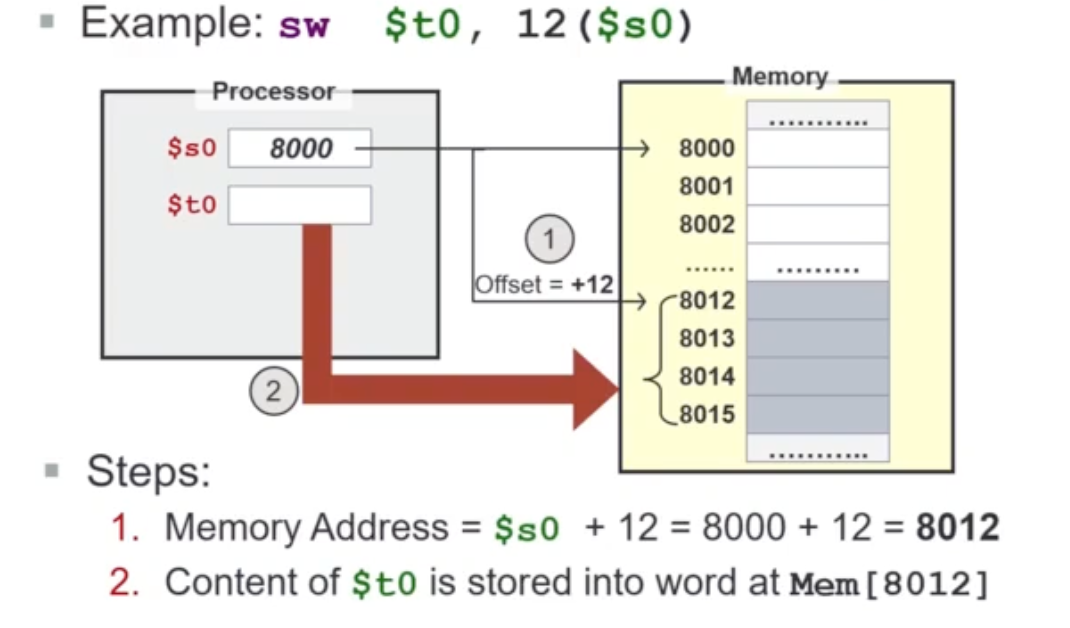
- move from register to memory
Load and Store Instructions
- only
loadandstoreinstructions can access data in memory - e.g. c code
A[7] = h + A[10]
// assign A -> $s3, h -> $s2
MIPS Code
lw $t0, 40($s3)
add $t0, $s2, $t0
sw $t0, 28($s3)
- remember: arithmetic operands (for add) are for registers, not memory!
- MIPS disallows loading/ storing unaligned word using
lw/sw- pseudo-instructions: unaligned load word, unaligned store word
ulw,usw
- pseudo-instructions: unaligned load word, unaligned store word
Other Instructions
- load byte (
lb): loads a singular byte into the register - store byte (
sb): stores a singular byte from the register into the memory address- takes the lowest byte of data from register
- note that offsets no longer needs to be a multiple of 4 (unlike words)
**Key Concepts: **
- Registers do not have types
add $t2, $t1, $t0:$t1and$t0should have 32-bit 2s bitslw $t2, 0($t1):$t1should contain address
- Consecutive words addresses in machines with byte-addressing do not differ by 1
- to go to the next word, need to increment the address in a register by the sie of the word
Swapping Elements using MIPS
Sample Code
swap( int v[], int k)
{
	int temp;
	temp = v[k];
	v[k] = v[k+1];
	v[k+1] = temp;
}
Variables Mapping
k -> $5
Base address of v[] -> $4
temp -> $15
MIPS Code
sll $2, $5, 2 (calculate the offset of v[k])
add $2, $4, $2 (computes address of v[k] and stores in $2)
lw $15, 0($2) (loads v[k] into register)
lw $16, 4($2) (loads v[k + 1] into register)
sw $16, 0($2)
sw $15, 4($2)
Making Decisions
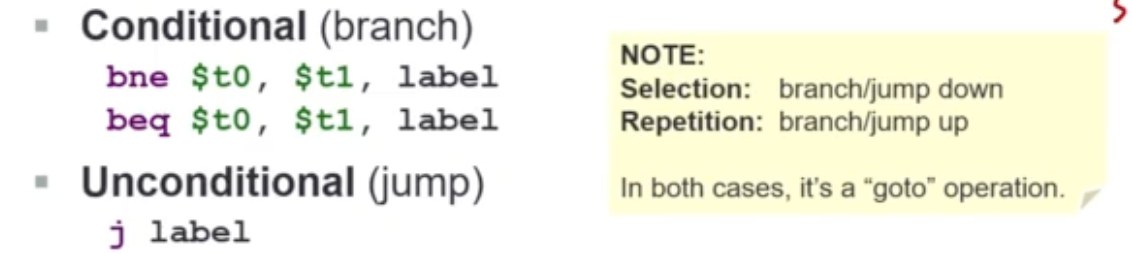
- bne: Branch if not equal
- check t0 and t1, if both are equal, it will go to the next instruction after bne
- else it is taken to branch
- beq: branch if equal
- check t0 and t1, if both are equa, it will go the label
- else it will go to the next lne
- Uncnditional(jump):
j label- technically equivalent to
beq $s0, $s0, L1 - Will jump to the label
- technically equivalent to
Label is an anchor in the assembly code to indicate point of interest.
Writing IF Statements in MIPS
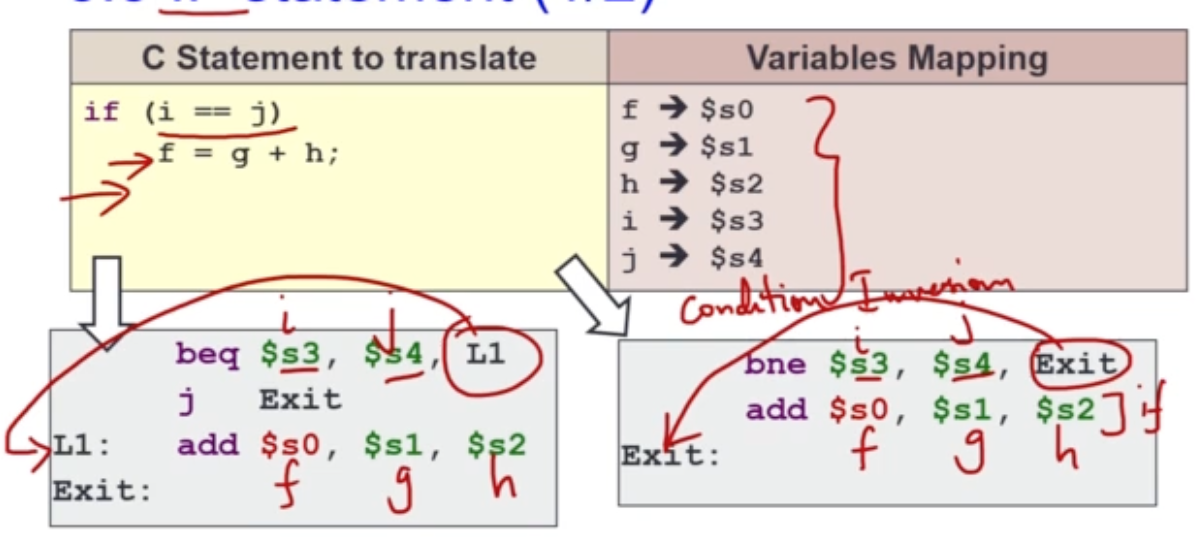
- try to invert the condition for a shorter code
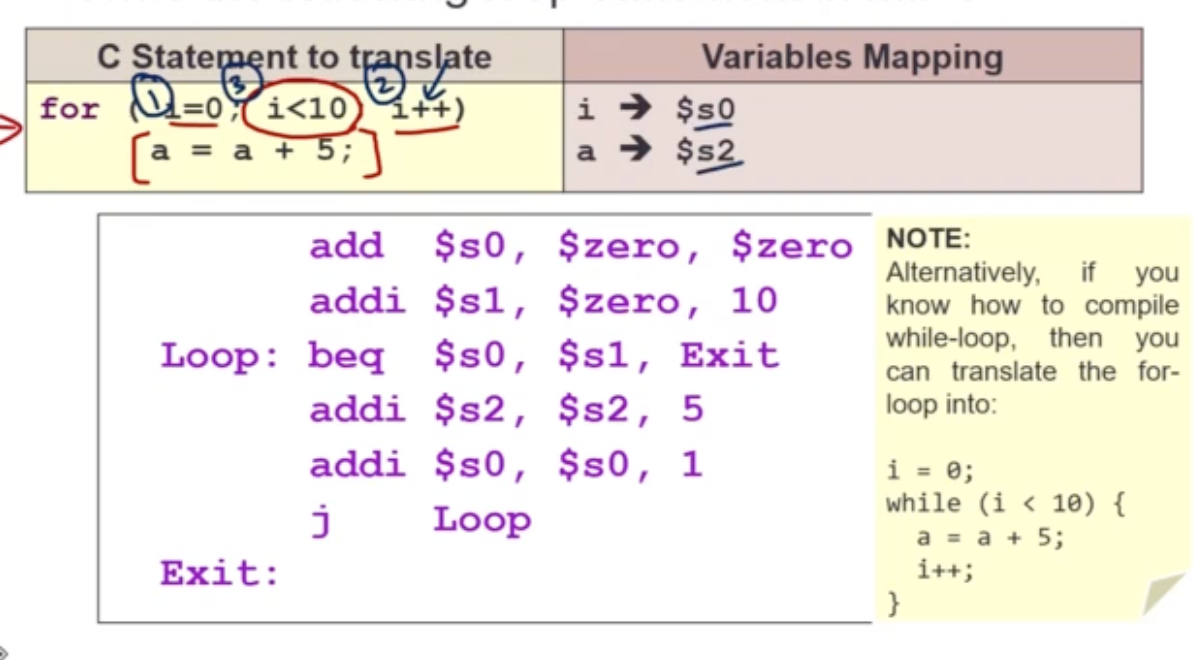
Writing loops in MIPS

Inequalities
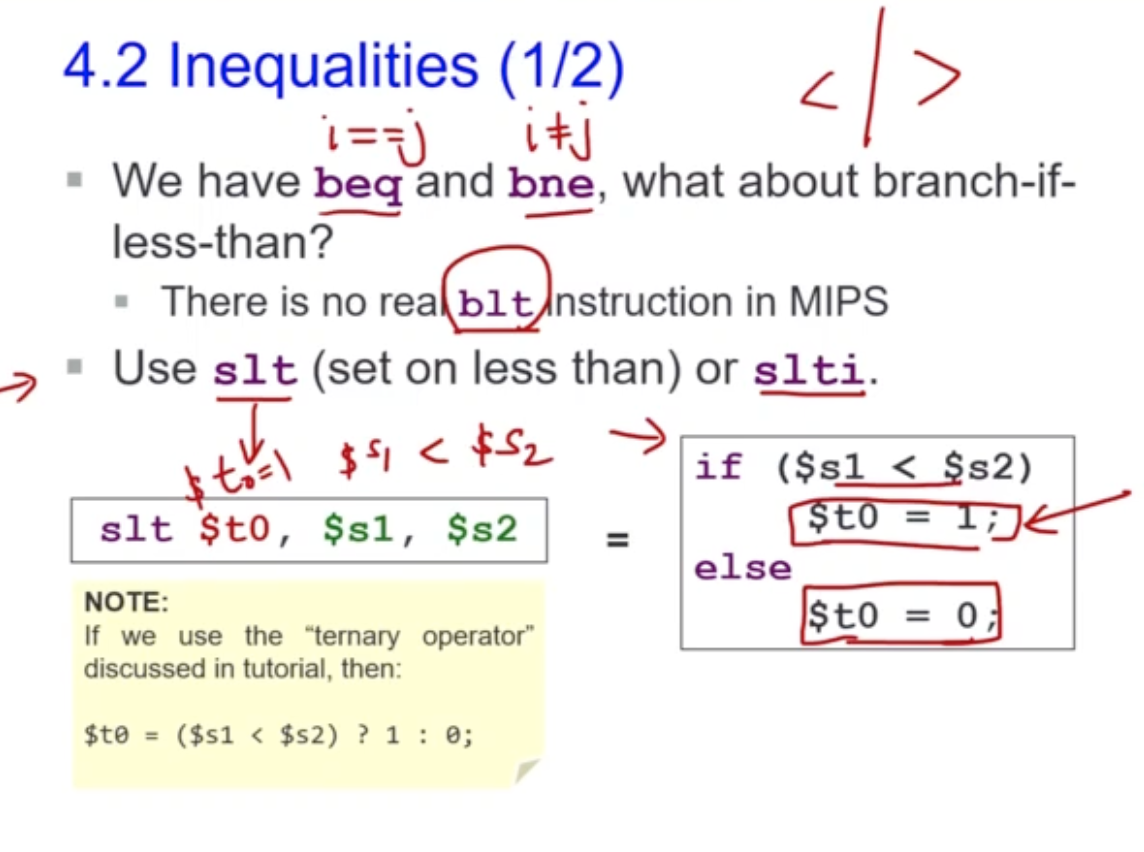
- check if t0 == 1 afterwards to see if s1 is < s2
sltandslti
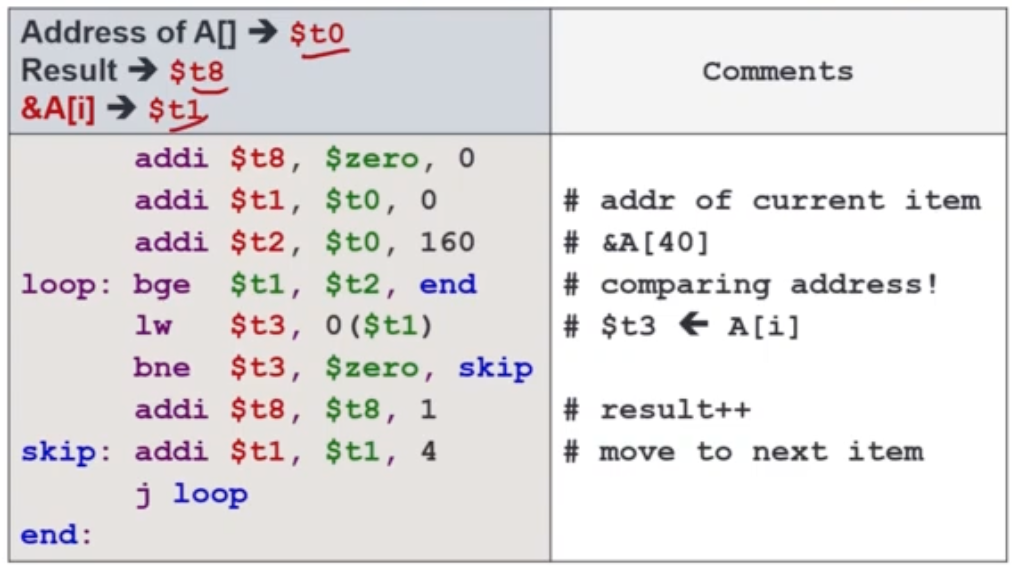
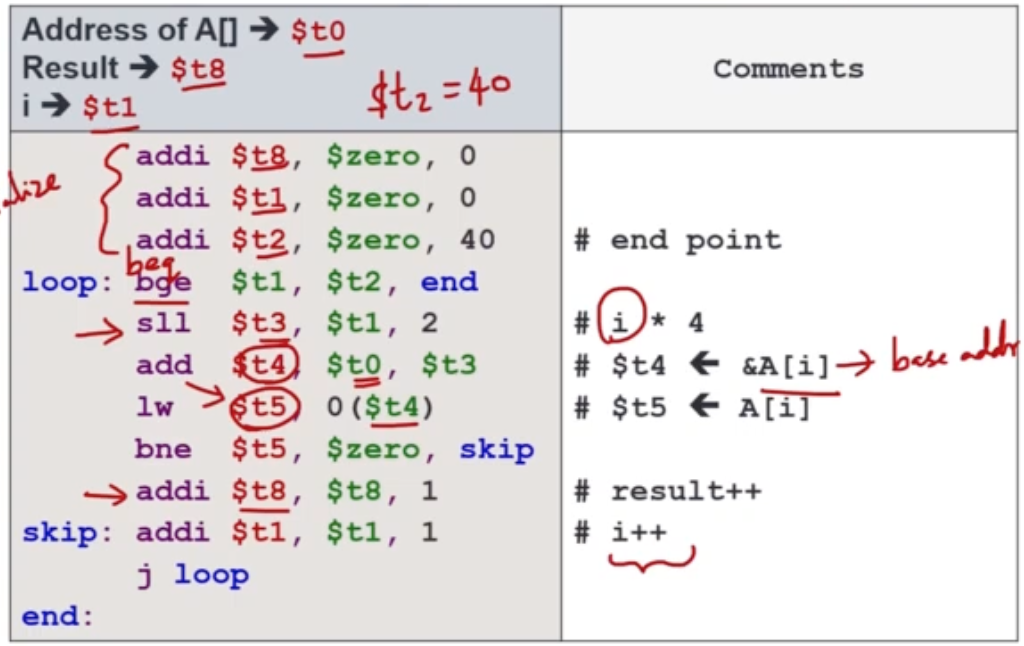
Array and Loop
result = 0
i = 0;

while (i < 40) {
	if (A[i] == 0) {
		result++;
	}

	i ++;
}
Using Index
 Using Pointers (Address)